
Temas de Wittgenstein e Davidson
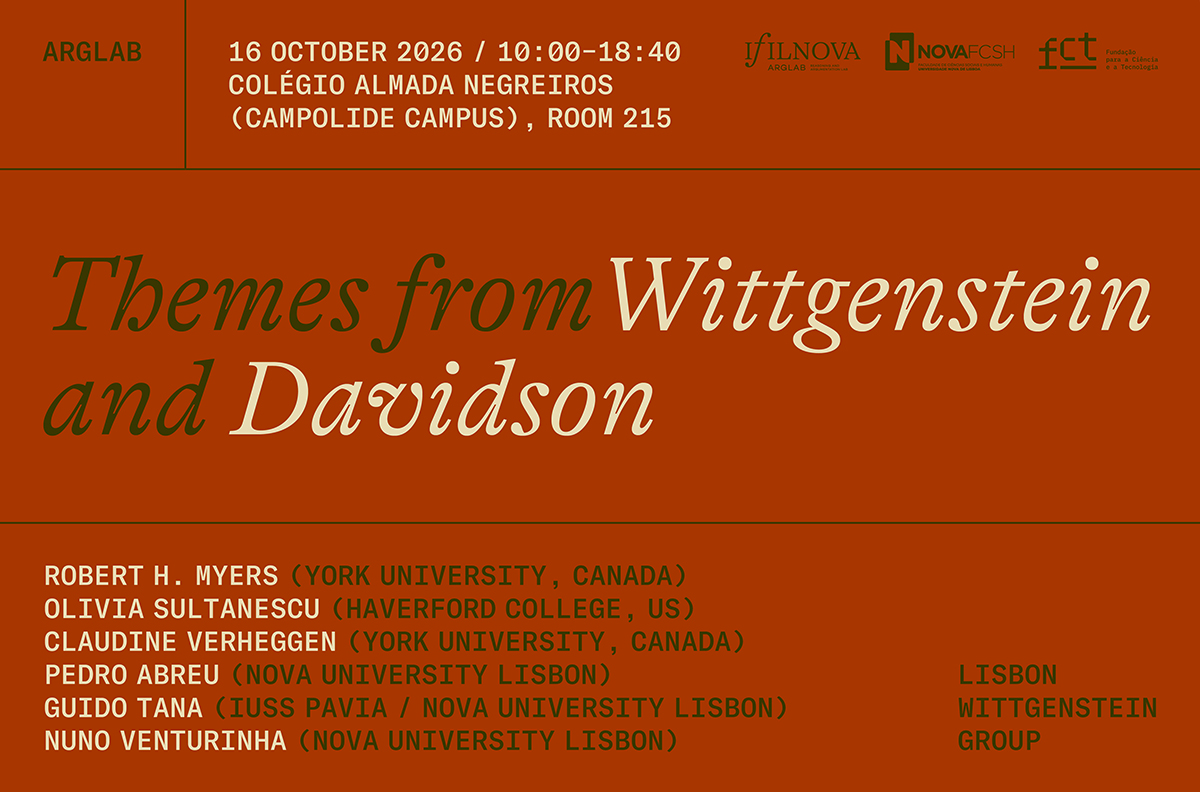
O workshop “Temas de Wittgenstein e Davidson” realiza-se a 16 de outubro na Sala 215 do Colégio Almada Negreiros (Campolide de Campus) e reúne investigadores que trabalham sobre temas das filosofias de Ludwig Wittgenstein e Donald Davidson. É organizado por Pedro Abreu e decorre no âmbito das atividades do Grupo Wittgenstein de Lisboa, coordenado por Nuno Venturinha (IFILNOVA).
ORADORES
Robert H. Myers (Universidade Iorque, Canadá)
Olivia Sultanescu (Haverford College, EUA)
Claudine Verheggen (Universidade Iorque, Canadá)
Pedro Abreu (Universidade NOVA de Lisboa)
Guido Tana (IUSS Pavia/Universidade NOVA de Lisboa)
Nuno Venturinha (Universidade NOVA de Lisboa)
Programa
10:00–10:15 Welcome and introduction
10:15–11:15 Robert Myers (York University)
Actions, Normative Reasons, and Causes
11:20–12:20 Nuno Venturinha (NOVA University Lisbon)
Epistemology and Normativity
12:20–14:00 Lunch
14:00–15:00 Pedro Abreu (NOVA University Lisbon)
Charity and Hermeneutical Injustice
15:05–16:05 Olivia Sultanescu (Haverford College)
The Nature of Linguistic Agency
16:05–16:35 Coffee break
16:35–17:35 Guido Tana (IUSS Pavia / NOVA University Lisbon)
Rule-Following as an Underdetermination Problem: Rational Authority, Triangulation, and Scorekeeping
17:40–18:40 Claudine Verheggen (York University)
Investigating Meaning and Use from the Interpersonal Point of View
________
Actions, Normative Reasons, and Causes
Robert Myers (York University)
My title is a play on Davidson’s, and his “Actions, Reasons, and Causes” will be my starting point. I begin, in Section 1, by acknowledging that, as presented in this early paper, Davidson’s causal theory of action was too reductive. But I then argue, in Section 2, that Davidson later developed the resources to do better. In particular, I argue that the more holistic conception of pro-attitudes developed in his subsequent writings strengthened his position on this front quite considerably.
My principal goal in this paper, however, is to open a second front in the dispute between Davidson and his critics, this time over the nature of normative reasons and their role in the explanation of pro-attitudes. As I argue in Sections 3 and 4, I believe that Davidson’s less reductive formulation of the causal theory of action makes possible an equally non-reductive version of meta-normative naturalism that could prove extremely difficult for his critics to contend with.
Epistemology and Normativity
Nuno Venturinha (NOVA University Lisbon)
Coming soon
Charity and Hermeneutical Injustice
Pedro Abreu (NOVA University Lisbon)
Charity tells us to interpret speakers so that their beliefs and utterances come out largely coherent, rational, and true. Early critics worried that this risks a form of linguistic or conceptual imperialism, making others intelligible by assimilating them to the interpreter’s own standards. Davidson has a strong reply. Charity is not optional, since substantial agreement is constitutive of interpretation itself.
Yet this does not guard against more local failures, where interpreters lack the conceptual resources needed to make adequate sense of particular experiences or features of the world. The problem need not involve radically different conceptual schemes, but only local mismatches in classification, articulation, or salience. Fricker’s notion of hermeneutical injustice identifies wrongful, socially structured forms such failures can take. The central question of this talk is whether charitable interpretation might systematically reproduce or reinforce hermeneutical injustice.
Davidson’s account of triangulation, together with his much less discussed reflections on the transformative power of dialogue, offers the beginnings of a response, registering that conceptual resources are formed and revised through interaction. However, these resources remain somewhat schematic about the process, and silent about the power dynamics central to Fricker.
The Nature of Linguistic Agency
Olivia Sultanescu (Haverford College)
What is the nature of linguistic agency, agency that involves the use of linguistic signs? Both Elizabeth Anscombe and Donald Davidson thought that there is a deep connection between agency and reasons. But a detailed account of how their conception of rational agency might bear on language appears to be missing from their work. Is linguistic agency just a species of rational agency, or should we conceive of it in a different way? Ludwig Wittgenstein, who influenced both Anscombe and Davidson, remarked that it is a characteristic of rule-following that one’s reasons are bound to give out, and one is then bound to act without reasons. This might be taken to suggest that the use of linguistic signs is not a case of reason-responsiveness, or at least not a paradigmatic case. However, I will argue that an adequate account of linguistic agency requires the materials of the basic conception of rational agency shared by Anscombe and Davidson. The speaker’s point of view is entirely a practical point of view. It is the perspective of someone who can appreciate and be moved by reasons through and through.
Rule-Following as an Underdetermination Problem: Rational Authority, Triangulation, and Scorekeeping
Guido Tana (IUSS Pavia / NOVA University Lisbon)
The presentation develops an interpretation of Kripke’s rule-following problem as a problem of rational underdetermination. Davidson’s triangulating response to Kripke’s rule-following problem, understood along Sultanescu & Verheggen (2019), is then assessed in this light. It is argued that it provides an attractive response because it situates the institution of normative standards within intentional ‘taking’ relations between speakers and a shared environment. However, a lingering underdetermination problem remains in Davidsonian triangulation: what makes the speakers’ determinate ‘takings’ themselves non-arbitrary, or anything other than a mere fallback on agreement between subjects? It is suggested that the Davidsonian picture, to provide a better answer, should be integrated within an understanding of I-thou normativity grounded in mutual accountability, following Brandom’s account of deontic scorekeeping.
Investigating Meaning and Use from the Interpersonal Point of View
Claudine Verheggen (York University)
Traditionally, those who believe that there is a close connection between meaning and use pursue their philosophical investigation into the nature of meaning from a third-person point of view. And they arrive at one or the other of two strikingly different conclusions: either meaning can be accounted for in non-semantic, behaviouristic terms, or it cannot be accounted for in any philosophically instructive way. A notable exception to the third-person approach has been provided by Saul Kripke, who made a point of investigating meaning from a first-person point of view, but who then reached a devastating conclusion: strictly speaking, no linguistic expressions ever mean anything.
I take it that neither semantic reductionism, nor semantic quietism, nor semantic scepticism are acceptable. Fortunately, however, there is a way to avoid all these options, for there is a third way of investigating meaning, first emphasised by Donald Davidson: the interpersonal way, considering language users as they respond to each other and to the environment they talk about. It then turns out that we can have a constructive, albeit non-reductionist, account of meaning. Meaning is revealed to be, not only essentially dependent on social factors and physical factors external to language users, but also in interesting ways essentially normative.